How I Quietly Transformed My Health with Qigong—One Breath at a Time
For years, I chased quick fixes—diets, workouts, supplements—but my energy still crashed by 3 p.m. Then I tried qigong. No hype, no pain, just slow movement and breath. Within weeks, my sleep deepened, my focus sharpened, and my stress didn’t just fade—it dissolved. This isn’t about miracles. It’s about consistency. After six years of daily practice, my blood pressure, heart rate variability, and mood logs show real shifts. Here’s how this quiet practice reshaped my health from the inside out.
The Breaking Point: When Modern Health Hacks Failed Me
For over a decade, I believed that health meant intensity. I cycled through every trend promising faster results: ketogenic diets that left me irritable and foggy, intermittent fasting that made me light-headed by mid-morning, and high-intensity interval training that left me sore for days. Each regimen came with bold claims and enthusiastic testimonials, but none delivered lasting change. I could check the boxes—exercise five times a week, eat organic, track macros—yet by 3 p.m., I was reaching for coffee and chocolate, desperate for a second wind. My doctor said my lab work was normal, which should have been reassuring. But I knew something was off. I wasn’t sick, but I wasn’t truly well either.
The truth emerged not in numbers but in subtle daily struggles. I would wake up tired despite eight hours of sleep. My digestion was unpredictable—sometimes sluggish, sometimes urgent. I found myself snapping at my children over small things, then feeling guilty minutes later. These weren’t crisis symptoms, but a steady undercurrent of imbalance. Modern medicine, focused on diagnosing disease, often overlooks these gray areas of fatigue, low-grade anxiety, and mental fog. Yet they are real, and they erode quality of life. I began to wonder if wellness wasn’t about pushing harder, but about learning how to slow down in a way that actually restored energy instead of depleting it.
That realization marked a turning point. Instead of asking, “What more can I do?” I started asking, “What if I need less—but more consistently?” I wasn’t looking for another extreme solution. I wanted something sustainable, gentle, and rooted in presence rather than performance. I didn’t know it yet, but I was ready for qigong.
Discovering Qigong: A Slow Fix in a Fast World
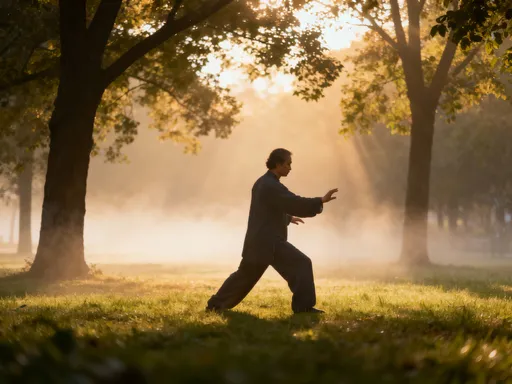
My first encounter with qigong came at a community wellness fair, tucked between booths selling herbal teas and ergonomic pillows. A small group stood in a circle, moving slowly, arms rising and falling like waves. No music, no instructor shouting cues, no sweat. Just calm, coordinated motion. I watched, skeptical. It looked too simple to be effective. How could something so quiet possibly make a difference in a body that felt constantly overwhelmed?
Curiosity got the better of me. I joined the next session. The instructor, a woman in her sixties with a steady voice, guided us through a series of gentle stretches and flowing motions. We were told to breathe deeply into the lower abdomen, to move with intention, and to keep our attention on the sensations in our body. There was no goal, no count, no rush. After ten minutes, something unexpected happened: I felt present. Not distracted, not planning, not worrying. Just here. My shoulders had dropped. My jaw, which I hadn’t realized was clenched, relaxed. For the first time in weeks, my mind wasn’t racing ahead to the next task.
That brief experience stayed with me. I started practicing at home for just five minutes each morning. I followed a basic routine—lifting the sky, separating heaven and earth, waving the arms like clouds. No special clothes, no equipment, no downloads. Just me, my breath, and a quiet corner. What surprised me most was how quickly it became something I looked forward to, not another item on my to-do list. Unlike the grueling workouts I used to force myself through, qigong didn’t leave me drained. It left me grounded. Over time, I increased to twenty minutes a day, always in the morning, always before checking my phone. The practice wasn’t flashy, but it was faithful—and so was the change it brought.
What Really Changed? Tracking the Quiet Wins
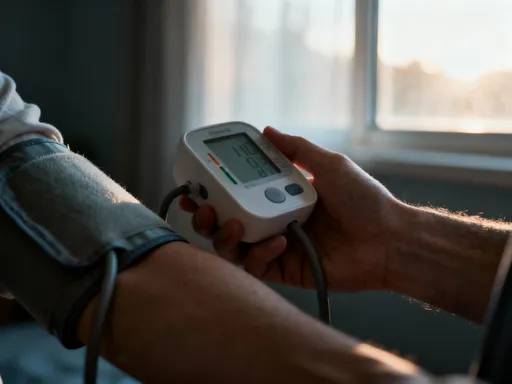
The shifts weren’t dramatic at first. There was no sudden weight loss or viral transformation. Instead, I noticed small, consistent improvements that accumulated over time. I began keeping a simple journal, tracking things like how I felt upon waking, my energy levels throughout the day, and my ability to fall and stay asleep. I also started monitoring my resting heart rate using a basic wearable device. Within six weeks, I saw a change: my average resting pulse dropped from the mid-70s to the low 60s. I didn’t set out to lower my heart rate, but the body responds to calm.
Sleep improved next. I used to wake up multiple times a night, often due to racing thoughts or physical restlessness. After three months of daily qigong, I began sleeping through the night. More remarkably, I started waking up before my alarm, feeling refreshed rather than groggy. My digestion also stabilized. The bloating and irregularity that had been a background hum in my life began to fade. I didn’t change my diet, yet my body seemed better able to process food. Even my skin looked clearer, though I can’t claim that was directly from qigong—only that everything felt more in balance.
These changes pointed to a deeper shift: my autonomic nervous system was recalibrating. Qigong, with its emphasis on slow, rhythmic breathing and mindful movement, gently activates the parasympathetic nervous system—the “rest and digest” mode. This counters the overactive “fight or flight” state many of us live in due to chronic stress. Research has shown that practices combining breath and movement can support healthier cortisol patterns and improve nervous system regulation. I wasn’t trying to fix a disease; I was supporting my body’s natural ability to self-regulate. And that, it turns out, makes a profound difference.
The Science Behind the Stillness
At first, I dismissed the idea that something so gentle could have measurable effects. But the more I practiced, the more I wanted to understand why it worked. I began reading about the physiology of breath and movement. What I found wasn’t mystical—it was physiological. Diaphragmatic breathing, a cornerstone of qigong, stimulates the vagus nerve, which plays a key role in regulating heart rate, digestion, and emotional state. When we breathe deeply and slowly, we signal to the brain that we are safe, which in turn reduces stress hormones like cortisol.
One of the most meaningful metrics I tracked was heart rate variability (HRV). HRV measures the variation in time between heartbeats. Higher HRV is generally associated with better cardiovascular health and greater resilience to stress. While not a diagnostic tool, it’s a useful indicator of autonomic balance. Before starting qigong, my HRV was in the lower end of the normal range. After six months of consistent practice, it had increased significantly. This didn’t happen overnight, but the trend was clear. My body was becoming more adaptable, more responsive, more resilient.
Studies on mind-body practices support these observations. Research published in journals such as *Frontiers in Psychology* and *Evidence-Based Complementary and Alternative Medicine* has found that qigong and similar practices can support healthy blood pressure, improve sleep quality, and enhance mood. These benefits are thought to come from the combined effect of rhythmic movement, focused attention, and deep breathing—all of which help regulate the nervous system. Importantly, these practices work with the body’s natural rhythms rather than pushing it to extremes. They don’t promise overnight cures, but they do offer a sustainable way to support long-term wellness.
Building the Habit: How I Made It Stick for Years
The real challenge wasn’t learning qigong—it was sticking with it. Like so many well-intentioned efforts, I knew it would be easy to start and hard to maintain. I didn’t want to fall into the cycle of enthusiasm followed by abandonment. So I approached it like building any new habit: with patience, simplicity, and self-compassion. I started with just five minutes a day, often right after brewing my morning tea. I didn’t wait for the “perfect” time or space. If I was tired, I did a shorter version. If I was traveling, I practiced in my hotel room or even in the airport.
I paired the practice with an existing routine—drinking tea—so it became a natural part of my morning. I also used a simple habit-tracking app to mark each day I practiced. Not to shame myself on missed days, but to celebrate consistency. I learned early on that perfection wasn’t the goal. Missing a day didn’t mean failure; it meant I was human. What mattered was returning to the practice without judgment. Over time, it became non-negotiable, like brushing my teeth or locking the door at night.
Another key was keeping it accessible. I didn’t invest in expensive classes or equipment. I used free online videos and a printed guide from a local library. I focused on a few core movements I could do anywhere. This lowered the barrier to entry. On busy days, I reminded myself that even two minutes of mindful breathing counted. The message wasn’t “do it perfectly,” but “do it regularly.” And that small, daily commitment added up in ways I never expected.
Beyond the Body: Mental Clarity and Emotional Steadiness
The physical changes were welcome, but the mental and emotional shifts were even more profound. I began to notice that I was less reactive. When my child spilled juice on the carpet or my internet went out during a work call, I didn’t spiral into frustration. I paused. Took a breath. Responded instead of reacted. This wasn’t because my life got easier—it didn’t. It was because my inner landscape had changed.
Qigong is as much a mental practice as a physical one. The focus on breath and movement trains attention in much the same way that lifting weights strengthens muscles. Over time, this builds what neuroscientists call attentional control—the ability to direct and sustain focus. I found that I could concentrate better during tasks, resist distractions more easily, and make decisions with greater clarity. I wasn’t more productive in the frantic sense, but I was more present, which made me more effective.
Emotionally, I felt steadier. The mood swings that used to catch me off guard—irritability in the afternoon, sudden sadness for no reason—became less frequent and less intense. I didn’t eliminate emotions, nor did I want to. But I developed a greater capacity to observe them without being swept away. This emotional regulation is supported by research showing that mind-body practices can increase activity in the prefrontal cortex, the part of the brain involved in decision-making and emotional control. I wasn’t trying to become a monk, but I was becoming more myself—calmer, clearer, more grounded.
A Practice, Not a Cure: Staying Grounded in Reality
It’s important to be clear: qigong is not a cure-all. When I sprained my ankle last year, I didn’t rely on breathing exercises alone. I saw a physical therapist, followed medical advice, and rested as needed. When I had a persistent cough, I visited my doctor. Qigong has never replaced professional medical care. Instead, it has become a daily support system—a way to nurture my body and mind so I’m better equipped to handle life’s challenges, including illness.
I’ve also learned to manage expectations. There are days when I don’t feel any different after practicing. Some mornings, my mind is still busy, my body stiff. That’s okay. The value isn’t in the immediate feeling, but in the long-term pattern. Wellness isn’t a destination; it’s a practice. And like any practice, it requires patience and persistence. I don’t do qigong because I expect a dramatic result each day. I do it because it aligns me with a rhythm of care, one that honors my body’s need for movement, breath, and stillness.
For anyone considering qigong, I encourage starting small and staying consistent. Let go of the need for quick results. This isn’t about fixing yourself—it’s about showing up for yourself. It’s about creating space in a busy life to reconnect with your breath, your body, and your sense of balance. It won’t solve every problem, but it can change how you meet them.
Conclusion
Looking back, the most powerful change wasn’t in my numbers—it was in my relationship with my body. Qigong taught me to listen, to move gently, to breathe fully. It showed me that health isn’t about punishment or performance, but about presence and patience. Six years in, it’s not just a routine; it’s a quiet commitment to showing up for myself, day after day. I no longer chase energy—I cultivate it. I don’t fight stress—I regulate it. And in the stillness between breaths, I’ve found a deeper kind of strength. One that doesn’t shout, but endures.